
Is DIY Umrah better? Yes, it can be, especially for experienced travelers who value flexibility and control. But there's a catch: booking everything yourself doesn't necessarily mean you're making independent decisions.
Your hotel choices, flight options and even your itinerary may be influenced by paid advertisements, sponsored influencers, online travel agencies and AI recommendations. You may be the one clicking the booking button, but who decided which options you saw in the first place?
That's a question more independent Umrah travelers should be asking.
The Illusion of Independent Choice
Imagine planning your first Umrah from Toronto.
You search Google for the best hotels near Masjid al-Haram. You watch a few YouTube reviews. Instagram shows you beautiful rooms overlooking the Kaaba. Booking.com recommends several properties. Finally, you ask ChatGPT to prepare a ten-day itinerary.
Within an evening, you have a shortlist.
You feel informed. You feel confident. And most importantly, you feel independent.
But consider what actually happened.
Google determined which search results you encountered. An advertising auction helped determine which sponsored results appeared.
Social media algorithms influenced which hotel videos reached you.
An online travel agency ranked properties using its own commercial and performance criteria.
And an AI system assembled recommendations from information it could access, which may or may not reflect current conditions.
You made the final decision.
But how independently did you arrive at it?
When a Hotel Pays More, Can It Become More Visible?
Let's examine something that isn't a conspiracy. It's disclosed in the business model.
Booking.com explains that its accommodation rankings consider factors such as customer reviews, availability, booking performance and commercial relationships.
It also acknowledges that commission levels and participation in certain partner programs can influence visibility.
Think about that for a moment.
A traveler searching for the best hotel in Makkah may assume the properties appearing near the top are simply the most suitable.
But suitability and commercial visibility are not necessarily the same thing.
This doesn't mean the highest-ranked hotel is bad, or that every ranking is purchased. It means the ranking is produced by a platform with its own commercial interests.
Google also sells advertising alongside its organic search results, although it states that advertising payments do not influence organic rankings.
The distinction matters.
But so does the larger question.
When you see a hotel recommended, do you know why you're seeing it?
The Influencer Who Loved Your Hotel
Now consider the travel influencer.
You watch someone enjoying breakfast overlooking the Haram. The room is beautiful. The service looks exceptional. The video receives thousands of likes.
You add the hotel to your shortlist.
But did the influencer pay for that stay?
Was the room complimentary?
Was there an affiliate commission?
Was the visit during a quiet period when service was easier to deliver?
None of these questions automatically makes the recommendation dishonest.
Many creators share genuinely valuable experiences, and sponsorships can be properly disclosed.
But a recommendation shaped by a commercial relationship deserves different scrutiny from one based entirely on independent experience.
In the United States, the Federal Trade Commission requires disclosure of material relationships that could affect the credibility of endorsements.
That requirement exists for a reason.
A beautiful hotel video tells you what someone experienced. It doesn't necessarily tell you what your family will experience.
Even ChatGPT Tells You Not to Trust It Blindly
This is perhaps the most fascinating contradiction in modern travel planning.
People increasingly ask AI systems to recommend hotels, compare flights and prepare complete Umrah itineraries.
And the answers can be impressively detailed.
A ten-day itinerary. Hotel suggestions. Transportation options. Estimated costs. Everything presented in seconds.
But ChatGPT itself warns users:
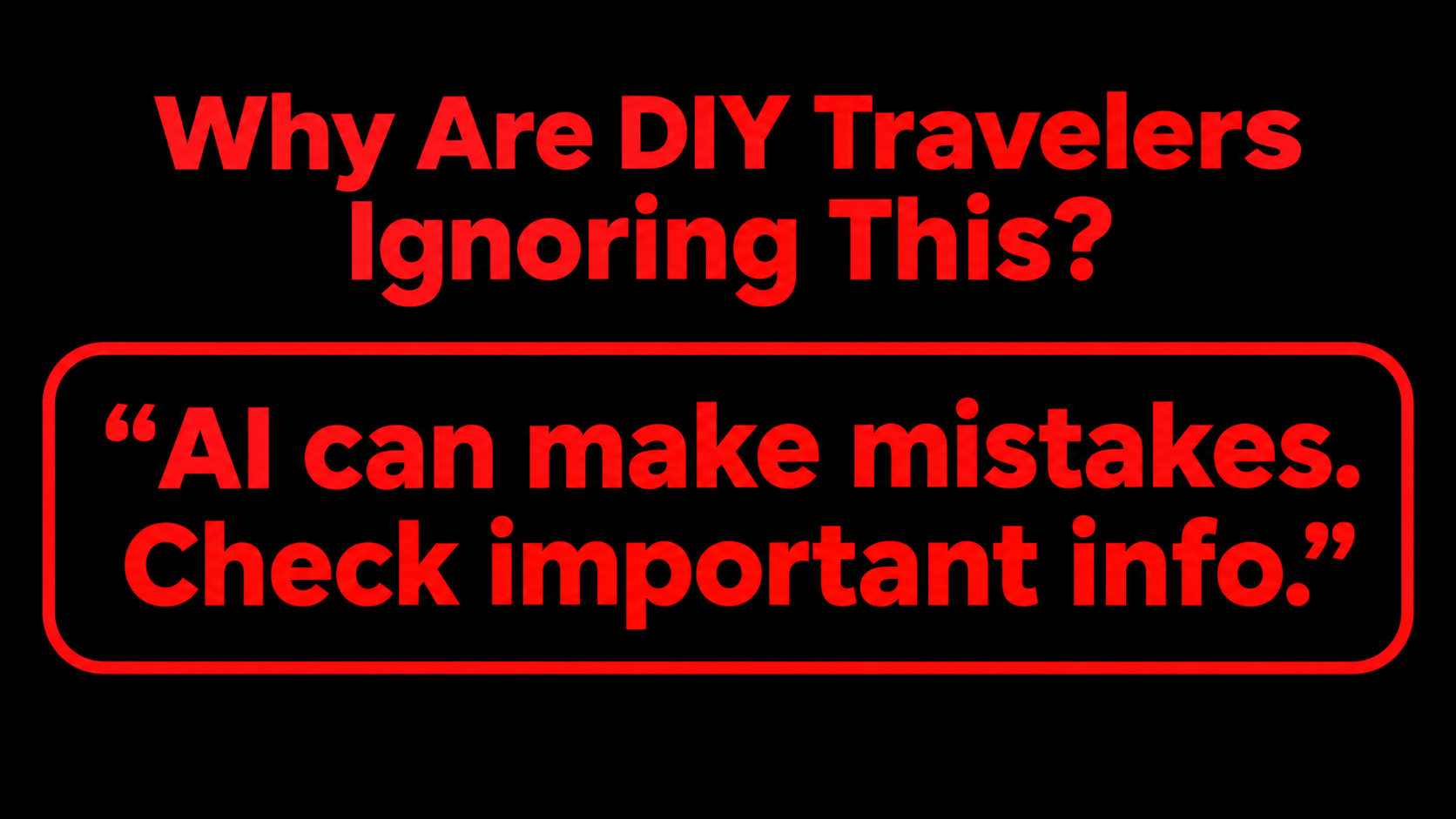
"ChatGPT can make mistakes. Check important info."
OpenAI's own guidance acknowledges that ChatGPT can produce incorrect information and sometimes sound confident while being wrong.
So here's my question.
If the technology itself tells you to verify important information, why would you treat its travel recommendations as verified facts?
AI can be useful for research. It can help you understand choices and organize your thinking.
But it may not know that a hotel's management has recently changed, that an advertised walking route is inconvenient for your elderly parents, or that transportation arrangements differ during your travel period.
Even when AI searches the internet, finding information is not the same as independently verifying conditions on the ground.
And unlike a person who has personally inspected a hotel or handled a travel disruption, an AI-generated answer does not establish who will be responsible if its recommendation proves unsuitable.
The real danger isn't that AI occasionally gets something wrong.
It's that a confident, detailed answer can make an unverified recommendation feel trustworthy.
Why Do We Blame the Hotel but Rarely Question the Recommendation?
Here's something I've observed in the travel industry.
When a hotel disappoints, travelers complain about the hotel.
When an airline delays a flight, they complain about the airline.
When a travel agent makes a mistake, they complain about the travel agent.
But what about the platform, influencer or AI recommendation that influenced the purchase?
How often do we ask whether the original recommendation was appropriate?
Of course, a booking platform may have contractual responsibilities and customer-support obligations. An influencer can be accountable for misleading advertising. Search engines and AI companies can also face scrutiny.
The point is not that these businesses are immune from criticism.
It's that travelers often focus on the company delivering the service without examining the system that influenced their decision to buy it.
A hotel may be excellent for one traveler and entirely unsuitable for another.
A recommendation can be technically accurate yet practically unhelpful.
And a booking confirmation doesn't prove the original decision was well informed.
The Real Question Isn't Whether DIY Umrah Is Good or Bad
Independent Umrah travel is not the problem.
Greater access to information, more flexibility and the freedom to choose your own arrangements are positive developments.
The concern is something different.
Have we confused the ability to book independently with the ability to evaluate recommendations independently?
Before accepting a hotel recommendation, understand who is making it, what information supports it, whether commercial incentives are involved and how recently the underlying facts were verified.
Use Google. Watch YouTube. Compare online travel agencies. Ask ChatGPT.
But question them all.
DIY Umrah isn't inherently better or worse. What matters is whether your decisions are genuinely informed. Technology has given pilgrims more freedom to book their journeys, but it has also introduced new influences over what they see, trust and ultimately purchase.
Before making your next Umrah booking, revisit one recommendation you've already accepted. Find out who made it, whether commercial interests were involved, and when the information was last verified. If you cannot answer those questions, you may need to reconsider how much confidence you're placing in it.
You may be booking Umrah yourself. Just make sure you're thinking for yourself, too.